A procurement change with structural consequences
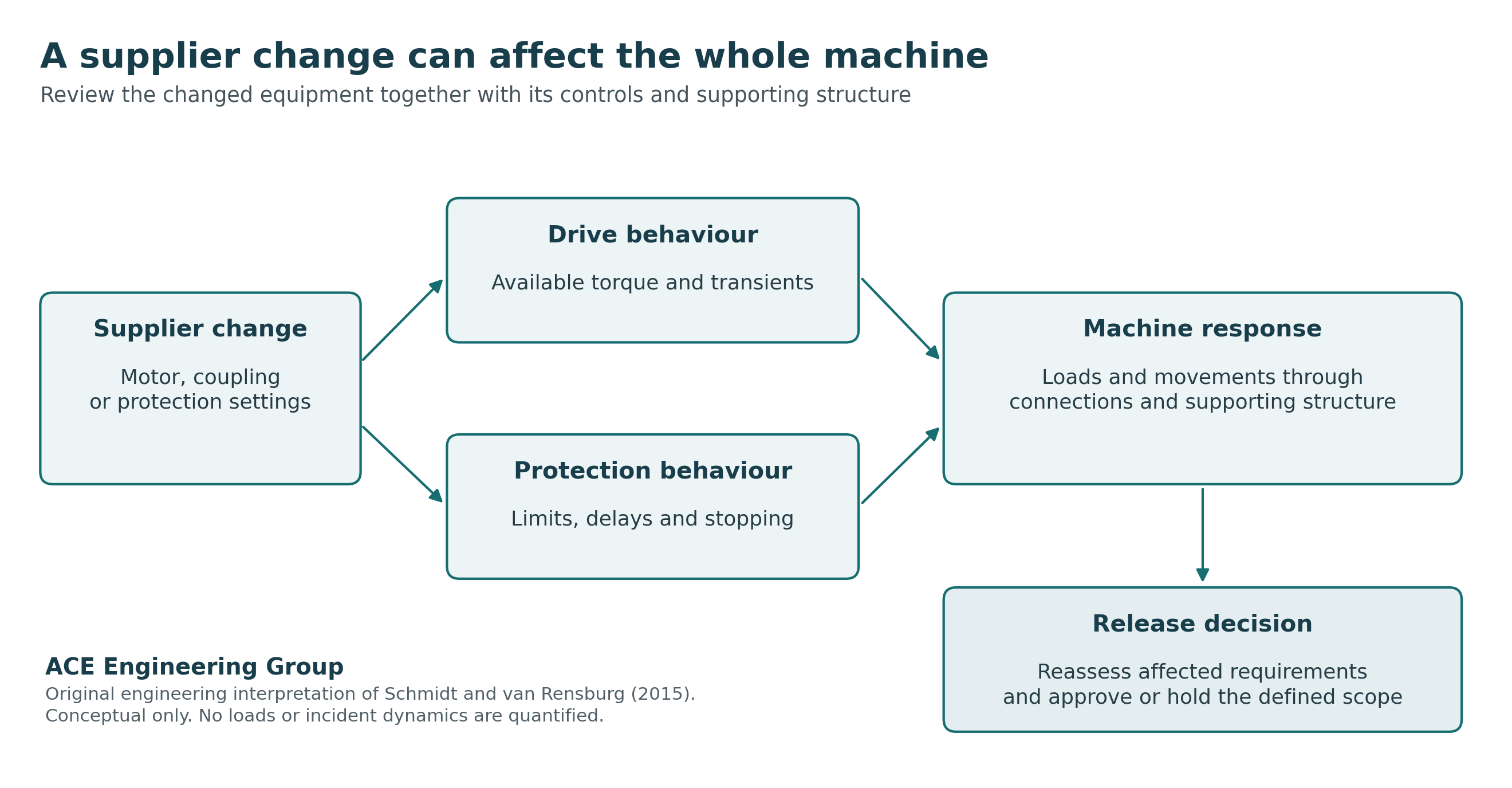
Schmidt and van Rensburg describe a portal reclaimer collapse investigation in which 185 kW motors were supplied in place of specified 160 kW units without consultation with the relevant design engineers. The investigation also identified unsuitable protection settings, overfilled fluid couplings and ineffective stockpile protection. [1, pp. 180 to 181]
These were interacting deficiencies. The paper does not establish that the motor substitution alone caused the collapse, or that the increase in rated power represented an equivalent increase in structural load. The lesson is to assess a substitution through the drive, protective functions and supporting structure before accepting it. This published case supports the integration lesson; it does not establish how frequently such failures occur.
Define readiness for the next commitment
Ordering a luff cylinder can constrain pin sizes, stroke and installation space. Selecting a slewing bearing can constrain its support ring. Freezing a portal arrangement can determine wheel positions and infrastructure loads. Identify the questions that could change each commitment and the evidence needed to resolve them.
A percentage completion label is useful only when it represents agreed inputs, deliverables and acceptance criteria. Retain the project gates, but define what must be demonstrated at each one. Some critical interfaces may need more development than the nominal overall percentage suggests. Safety, integration and contractual reviews also need their own timing.
Match the analysis to the decision. A preliminary model may resolve a support arrangement; a detailed local model may be needed early if a connection determines whether that arrangement is feasible. Model detail cannot compensate for an incorrect duty, restraint or failure assumption.
The WA plant code recommends checking suitability for intended use before purchase, including the operating environment and lifecycle risks. Safe Work Australia’s design guide also addresses manufacture, transport, installation, operation, maintenance and disposal. [2], [3] For a bespoke machine, translate these considerations into explicit requirements and evidence for the affected release.
Agree the duty and interfaces before comparing offers
Establish the material properties, throughput and operating ranges, retained material assumptions, environmental actions, specified fault responses and maintenance configurations. Include transport, erection and infrastructure constraints that could change the arrangement. Assign an owner to each input and define how changes reach the affected calculations, drawings and specifications.
Define the capacity being purchased. Instantaneous digging rate does not establish output over a complete reclaiming cycle: stockpile geometry, operating sequence and repositioning also matter. Annual output additionally depends on availability and utilisation. State the required performance and demonstration conditions so supplier offers can be compared on the same basis.
Use a traceable mass schedule for the installed configuration. A quoted component mass may exclude supports, electrical equipment, operating fluids or retained material. Record those boundaries and any justified uncertainty, because the mass and its location can affect balance, cylinder demand, wheel reactions and structural assessment.
Keep strength, stability, fatigue and maintainability visible. Sensitivity checks should test whether credible combinations of uncertain inputs change any acceptance criterion affected by the release. The selected cylinder or bearing might remain unchanged while a pin, support or protection requirement loses its justified margin.
Make operating limits achievable
Where the design relies on an operating limit, establish how that limit will be maintained, how departures will be detected and what action follows. A retained material allowance needs a credible cleaning arrangement, including access, accumulation rate, inspection and the consequences of delayed cleaning. An agreed limit is not evidence that the machine will remain within it. Prefer controls that reduce dependence on operator intervention where practicable. [3]
Where protection is relied upon, define the required response, response time, reliability and relevant fault behaviour with the responsible specialists. Check the machine response during detection and stopping as well as the final stopped condition. The risk assessment and applicable requirements must determine the necessary integrity; a general article cannot prescribe a universal SIL or performance level.
Turn field lessons into design requirements
Recurring cracks, inaccessible joints and difficult component replacement are useful review inputs. First establish the likely mechanism and whether the new machine shares the relevant geometry, support conditions and duty. Copying reinforcement from an older machine can add mass without addressing the cause.
WA Mines Safety Bulletin 124 identifies failures to communicate design intent and assumptions, and inadequate change management, among structural integrity problems. [4] Preserve the reason for a critical detail and define the evidence needed to verify the proposed response.
| Field lesson | Response to investigate | Evidence before affected release |
|---|---|---|
| Recurring connection cracking | Reassess mechanism, load path, detail and duty | Compatible fatigue assessment and achievable fabrication detail |
| Inaccessible inspection location | Revise services, access and examination provision | Demonstrated access for the specified inspection method |
| Difficult component replacement | Define removal route, lifting and temporary support | Maintenance arrangement and staged load assessment |
| Unexpected load sharing | Review articulation, restraint and support stiffness | Bounded support model and installation checks |
| Protection did not limit demand | Coordinate detection, response and structural limits | Agreed functional requirements and verification plan |
A fatigue check needs a stress assessment compatible with the selected method and detail classification. A satisfactory weld inspection does not independently establish the operating load spectrum. For maintenance, check the actual removal sequence, temporary load paths and obstructions before the affected layout is fixed; an accessible walkway alone does not establish that a component can be replaced.
Give checking and approval distinct purposes
Design preparation develops the solution and its basis. Independent checking tests it within an agreed scope. Accountable approval authorises a defined commitment on the available evidence. Identify who integrates the discipline conclusions and who has authority for each release.
Additional checking can be justified where it controls a distinct risk, provides required competence or meets a contractual or regulatory requirement. Each check needs a purpose, owner, evidence and release decision. Distinguish required technical checking, required approval, useful optional work and duplication. A high engineering cost is a reason to examine the cause; it does not demonstrate that necessary assurance should be removed.
Make a conditional release specific
Separate the commercial order from technical permission to perform particular work. Reserving supplier capacity, commissioning concept studies, buying material and authorising manufacture create different commitments. A conditional release is justified only when the evidence supports its permitted scope and the conditions retain control of subsequent work.
Consider a hypothetical stacker cylinder order. Normal operating force has been calculated, but the required response to a specified cylinder failure and the final attachment geometry remain unresolved. Holding position, stopping safely and controlled recovery are different duties. An undefined governing failure duty prevents confirmation of a selection that depends on it.
The supplier needs the applicable force, pressure, stroke and geometry envelopes. The machine designer needs to assess pins, lugs and supporting structure together with the hydraulic and control functions relied upon. Cylinder safety guidance identifies failure behaviour, rod buckling, transverse loading and mounting restrictions among the selection considerations. [5]
In this example, the team could commission explicitly bounded concept studies to compare options while retaining the selection and manufacture hold points. Once the applicable duty and interface envelopes are justified, a separate release could permit detailed supplier design within those bounds. A named owner and a future deadline do not make an unbounded assumption acceptable.
| Release item | Illustrative decision while failure duty remains unresolved |
|---|---|
| Work permitted | Concept and option studies only, with provisional inputs and limitations identified. |
| Work held | Final cylinder selection, material purchase and manufacture that rely on the unresolved duty or attachment geometry. |
| Evidence for next release | Defined failure response; justified force, pressure, stroke and geometry envelopes; assessment of connected load paths and protection requirements. |
| Authority and control | Record technical ownership, checking scope and the authorised release decision. Obtain supplier acknowledgement of the permitted work, exclusions and next hold point. |
| Later verification | Retain supplier acceptance checks, installed interface checks and commissioning requirements as open until suitable results are assessed. |
For any release record, identify the authorised and held work, acceptance criteria, evidence and revisions, remaining uncertainty, responsible people and next hold point. Carry the same conditions into the purchase specification. Confirm supplier exceptions before comparing price or accepting an offer.
Apply the same discipline to other equipment. A slewing bearing assessment depends on the concurrent loads, duty, mounting and support behaviour. Manufacturer guidance explains that unsuitable support deformation can create local raceway overloads and requires a load spectrum and operating movements for selection. [6] The supplier assessment and the structure released for manufacture must use compatible assumptions.
Keep changes and verification open until supported
When a change to mass, geometry, duty, support stiffness or control settings leaves the approved envelope, reassess the affected calculations, interfaces and releases before authorising further affected work.
A substitute motor may fit while changing available torque. A different bearing may alter mounting and bolt requirements. A material substitution may change welding and fatigue details. Assess affected functions and interfaces before acceptance, revise the design records, and confirm that the supplied equipment, installed settings and final records match the approved change.
Defining a commissioning test closes the action to define that test. It does not demonstrate that the machine passed. Keep agreed requirements, conditional releases, outstanding verification and verified results distinct. A supplier certificate or guarantee supports only the scope and conditions it actually covers.
Plan acceptance evidence during design. Compare the installed configuration and relevant operating and protection responses with the assessed bounds. The WA plant code links commissioning to tests against design specifications. [2, section 3.2] Use controlled tests and analysis appropriate to the hazard; commissioning should not deliberately expose the machine to an unassessed overload.
Also check whether the specified performance meets the intended operating duty. A component can satisfy an incomplete purchase specification while the assembled machine falls short. Capture significant service observations against the accepted baseline and return them to the design team without assuming every field symptom proves a design error.
Separate assessment effort from design changes
Where AS 4324.1:2025 applies, use the controlled full standard and the agreed design basis to identify the actual requirements. A title, preface or summary cannot establish detailed load factors, compliance or a required modification. If the specified edition changes, compare the requirements with the existing assessment and identify affected deliverables.
Agree the scope, fee and programme allowance needed to establish that gap. Use the findings to determine any design changes and their cost and programme consequences. An assessment may be necessary and valuable even when it concludes that no physical modification is required.
ACE can structure an early structural and mechanical review around an approaching equipment order or drawing release. The useful output is a defined release recommendation, consequential gaps and an action plan that identifies the evidence needed for the next decision. The appointed project authority retains responsibility for the release within its agreed role.
References
[1] Schmidt MJ and van Rensburg BWJ (2015). Avoiding structural failures on mobile bulk materials handling equipment. Journal of the Southern African Institute of Mining and Metallurgy 115, pp. 179–184; portal reclaimer case pp. 180–181. Publisher paper
[2] Work Health and Safety Commission, Western Australia. Managing risks of plant in the workplace. Code of practice, sections 3.1 and 3.2. WorkSafe publication
[3] Safe Work Australia (2014). Guide for safe design of plant. Design guide
[4] Department of Mines and Petroleum, Western Australia (2015). Mines Safety Bulletin 124, Structural safety of buildings, plant and other structures. WorkSafe bulletin
[5] Parker Hannifin. Series 2HX / 3HX Family, catalogue HY08-1175. Cylinder Safety Guide. Supplier safety guidance
[6] thyssenkrupp rothe erde. Technical basics for companion structures and bearing selection. Companion structure Bearing selection